Hostile Soil
Sand, chalk, salt, rubble, hardpan. Stop trying to fix it.
Not for people with perfect gardens. For everyone else — every plant filed by the ground it survives, not the family it belongs to.
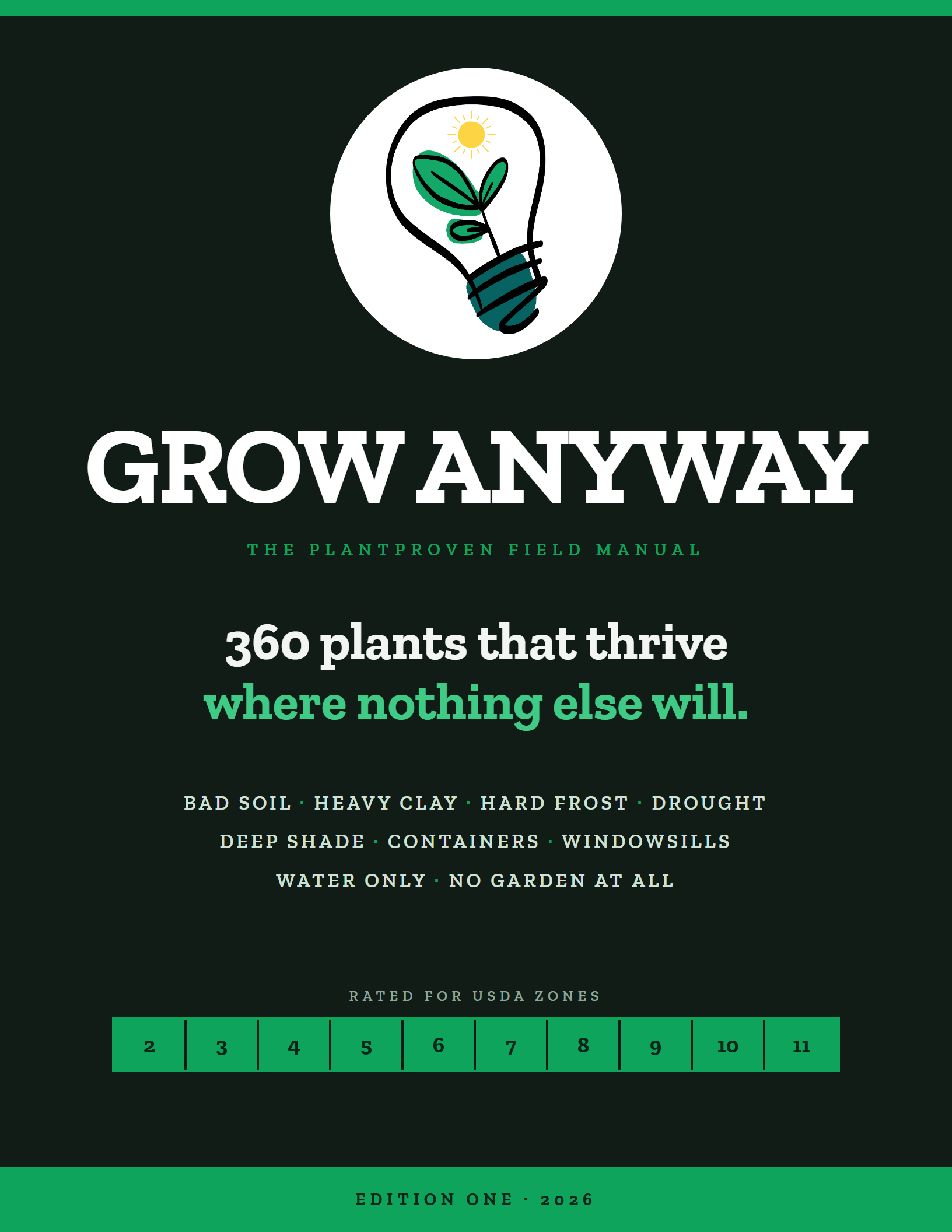
Instant PDF · $77 $47 this week · 7-day refund
One file — not a course, not a subscription, not a drip feed. Sent inside sixty seconds, read on a phone in the garden, printed at the kitchen table in type large enough to read standing up.
Illustrated PDF · 525 pages
Edition One · 2026
Instant access · Pay once · Yours forever · 7-day refund
Almost every failure on difficult ground traces back to advice written for good ground. Left, what you were told. Right, what this manual tells you instead.
One replaced fruit tree costs more than this book.
Buy it if your ground is the problem — or you have no ground at all. Skip it if you have deep loam, a long season and no complaints.
Each section opens with the argument, then runs the plants that hold it. Start with the one that matches your ground — the other twelve are there for the day your ground, your climate or your circumstances change.
Sand, chalk, salt, rubble, hardpan. Stop trying to fix it.
Concrete in August, standing water in February.
Zone 2 and a hundred frost-free days. Fruit that ripens anyway.
Hundred-degree weeks and hose bans, on the rain you already get.
Not plants that tolerate shade — plants that require it.
Balcony, patio, doorstep. Rated for pots, not just ground.
One bright sill and no garden at all.
A jar, a bucket, a half-barrel. No soil anywhere.
Privacy, a windbreak, or ground you never weed again.
Plant it once, eat from it for thirty years.
A small plot and a demand for real calories.
Pest control with plants, not a spray bottle.
The hungry gap and the winter hole, closed.
Decision charts, timeline, sourcing, 719-entry index.
Every gardening book tells you what to plant. This is the only one with fourteen pages of what not to — species banned two counties over, species that will be in your neighbour's lawn within three years, and species quietly poisoning everything within forty feet of the trunk.
Found in year four, a restriction costs a season and possibly a fine. Found on page 431, it costs nothing.
| Elderberry | Raw berries and green parts toxic. Cooked only — the entry says how. |
| Black walnut | Juglone kills tomatoes, apples and most of what you plant near it. |
| Comfrey | Superb fertiliser. Never internal, whatever the internet says. |
| Parsnip | Sap blisters skin in sunlight. Harvest covered, on a dull day. |
| Black locust | Added to a state noxious list in January 2026 — after the usual advice recommended it. |
Every entry carries a USDA zone scale from 2 to 11, rated twice — once in the ground and once in a pot, because they are not the same. Marginal zones are marked marginal rather than quietly included.
It is written for North America first, with a conversion appendix for the UK, Ireland, Australia, New Zealand and India.
Three full sections — 82 entries — assume you don't: containers and small spaces, windowsill and indoor, and water only with no soil at all. That covers a balcony, a north-facing flat, a rented room with one bright sill, and a jar on the kitchen counter.
Yes, and it is one reason the book is organised this way. Every container entry states the pot size the plant actually needs, and the permanent-crop section flags which of them can move house with you. Nothing in the container, windowsill or water sections needs a landlord's permission.
No. The register is a grower talking to another adult — no jargon for its own sake, no padding. Each entry is three short blocks: why it performs where others fail, how to plant it, and the mistake that kills it. That last block is the part beginners actually need, and it is in all 360.
For the shortest route in, start with the six decision charts at the back: your problem to a shortlist in about two minutes.
The videos give you a list. The book resolves it. On the channel's two biggest videos the top comment is a viewer manually typing out the plants so they don't lose them — this book exists because there was no artifact to keep.
Nothing here is a transcript. Every entry adds the zone scales, pot ratings, time to first crop, sourcing, the legal flag, the substitute and the failure mode — the things a ten-minute video has no room for.
The botanical plates are public-domain works — the USDA Pomological Watercolor Collection, Köhler's Medizinal-Pflanzen of 1887, Curtis's Botanical Magazine, Redouté — every one credited in the back. No identification image in this manual is AI-generated. That is a rule, not a preference: this audience corrects botanical detail in the comments already.
Every entry carries one of four risk ratings — Clear, Check locally, Restricted in some areas, Widely banned — and the book deliberately never asserts that a plant is legal in a named place. Counties adopt their own lists: black locust was added to a state noxious-weed list in January 2026, weeks after standard advice recommended it.
The rating is a risk class, not a legal determination. Wherever something is restricted, the entry names a substitute that does the same job.
A single illustrated PDF, 525 pages, US Letter, fonts embedded. It opens on any phone, tablet, Mac or PC and prints cleanly — the type is set large on purpose, and the index uses entry numbers rather than page numbers so it stays correct in every edition. Print the four pages you need for a weekend and leave the rest on the phone.
No. One payment, one file, yours permanently, including every future revision and edition at no extra charge. There are no affiliate links anywhere in the book — the sourcing advice occasionally amounts to telling you not to buy anything.
Reply to your Gumroad receipt within seven days and ask for the refund — no questions and no form to fill in. Gumroad returns it to the card or account you paid with. Keep the file. If the book didn't earn the $47, it shouldn't hold onto it.
360 plants filed by what they survive, across 525 pages. $121 of material for $47 this week — and every future edition free.
Get the manual · $47 →Open it, read the Kill List, read the section that matches your ground. If it doesn't tell you something you didn't know, reply to your Gumroad receipt inside seven days and ask for the refund — no questions and no form to fill in. It goes back to the card or account you paid with. You keep the file either way — we are not going to argue over a PDF.
Most people find out a plant was wrong for their ground three years in, when it is far too late to move it. $121 of material, $47 this week, seven days to change your mind.
Get the manual · $47 → Or see what's inside →